Tuesday, 5 February 2013

College magazine analysis


What images have they used? What camera angles/shots have been used?

The image that has been used is a medium shot of two children smiling at the camera.

What is the mise-en-scene on the front cover?

The mise-en-scene on the front cover is two children in front of a green park-like background grabbing onto something with another child in the background on the extreme left with their back turned to the camera. The child at the front of the shot has a striped vest on, the child in the centre is wearing an orange shirt and the child in background has a blue polo shirt. The lighting is bright with the natural sun most likely being used.

Does the front cover engage the audience and why?

In my opinion the front cover does engage the audience as it features a headline involving children and their futures which can be a curious subject to college students who care about their younger relatives or possible children and wish to know more about their futures.

Who is the target audience? Age, gender, ethnicity, lifestyle etc

The target audience for this college magazine would obviously be college students, but also to people who are looking to possible enrol in the college and take a course there. So this would be the age of 16+, both males and females of all ethnicities. I imagine the lifestyle would be those who have college as a prominent part of their lives and wish to continue reading about it.


How does the magazine engage the target audience?

How the magazine engages the target audience is by having the big red banner for the masthead and the large bright main image of the cover. The colours are smooth and easy on the eye compared to being too extravagant with too much going on.

How do you know it is for this particular target audience?

How you know it is for this target audience is it having 'University' prominently next to the magazine name meaning the magazine is based around that and targeted to people interested in colleges and universities.

What is the ideology of the magazine?

The ideology of this magazine is for college students to learn more news and find out more about the college they attend or are planning on attending.

What does the college consider important?

What the college considers important is the future of children who could potentially attend the college and using this to get people to pick up the magazine and read, as it could be a subject which means much to them.

Monday, 4 February 2013

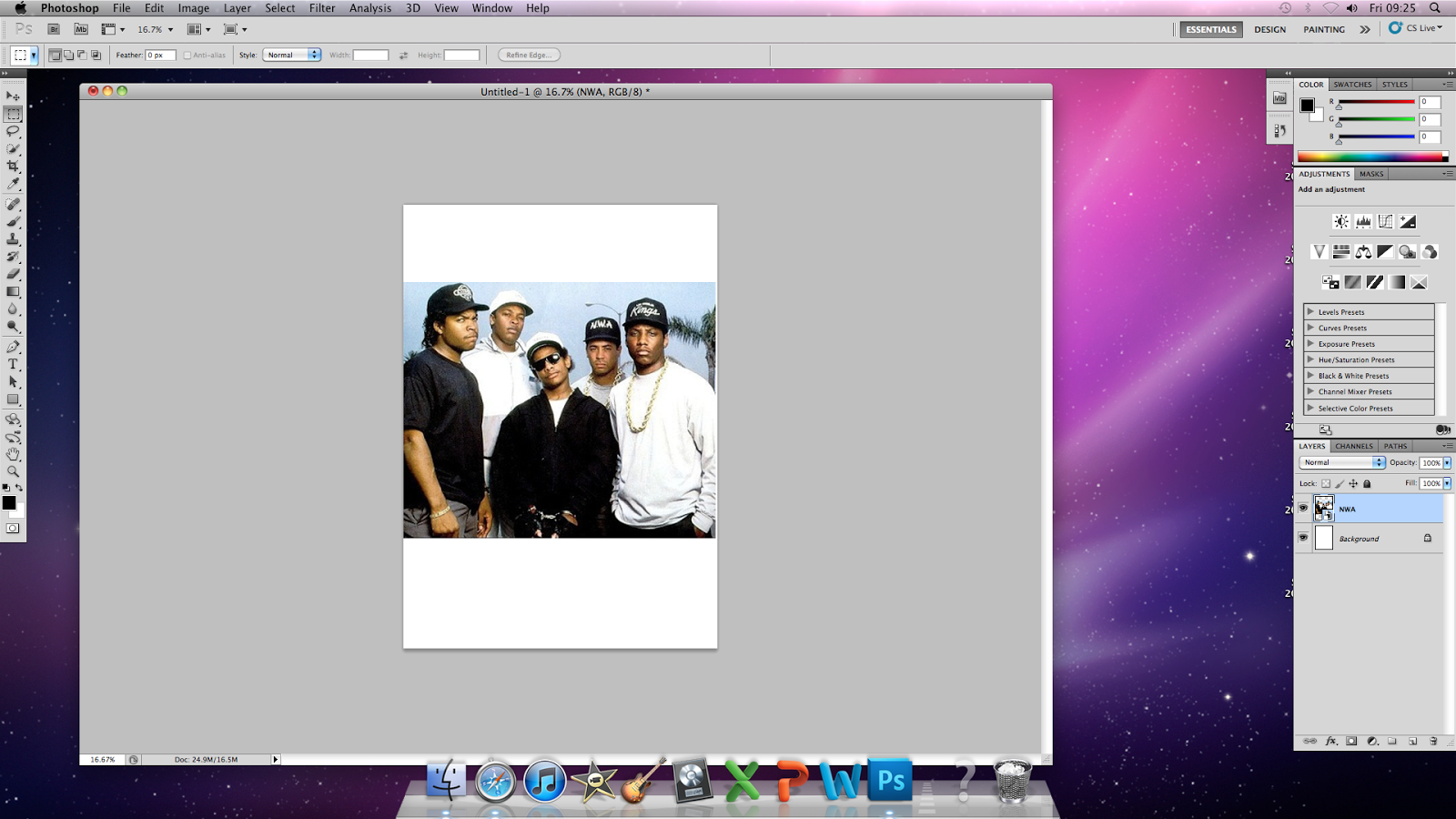
Using Photoshop


 I opened Photoshop and chose the paper size to be the standard A4.


I put in a picture of the hip-hop group N.W.A.


I right-clicked the layer of the picture and rasterised the image so it is available to edit.


I selected the Magic Wand tool...


...then removed the background as seen above.


I then inserted a background image which is completely different yet fits and looks like nothing has been edited.
While basic, these tools have helped me get used to Photoshop and be able create my magazine cover, contents and double page spread to a higher standard in the future.


Friday, 25 January 2013

Cohen's Moral Panic

A moral panic is the media (usually a newspaper) creating a form of hysteria among western society.

A folk devil is someone 'picked on' by the media and used as the scapegoat in Cohen's moral panic theory.
One example is Marilyn Manson, the musician who was blamed for the Columbine High School massacre because of the violent and dark content of his music.

More examples of folk devils are:
Chris Brown (domestic violence)
Rihanna (suggestiveness)
Michael Jackson (child abuse cases and out of the ordinary lifestyle)
Gary Glitter (child abuse case)

Thursday, 24 January 2013

Questionnaire results


After receiving 20 responses on my questionnaire, here are my results:

16 of the people who answered were male, which is over 3/4


The most common age group of the people answering was 14-16

I created two different questions involving music genres and adding the votes of both means Rap is the most popular genre with hip-hop 2nd. Due to the similarities of these genres and them being the top two, I will gear my magazine towards this genre and audience.


The most common price that people are looking to spend on a music magazine is between £2-£3.99, which was expected and will be the price of my fictional music magazine.


The next question was what is your favourite design for a magazine and the option with the most votes was 'Other' which suggests a hybrid of the two. So because of this result, my magazine will keep a simple design but with an average amount of things taking up the page to suit the audience.

Most people who said they don't buy music magazines answered they would purchase one in the future so with my magazine I plan on mine having enough quality to make it happen.
And the final graph asks what caused the person to stop, with most answers that aren't other being 'lost interest'. This means I should make my magazine as interesting as possible and have something different about it compared to the rest.

All of these results have given me help to who I should cater my magazine for and what it should be like, not straying too far from what I expected out of these results.

Friday, 18 January 2013

Feminism


How feminists would see this magazine is in quite a negative manner.
Rihanna is pictured centrally with her back to the camera and staring at the camera with a suggestive look on her face. Her outift is very revealing especially her shorts which leave her on show. This is quite bad for younger kids who look up to people like Rihanna and see this cover on the shelf, and it has the negative connotation of women being sex objects which feminists have worked out to 'stamp out' in pop culture today.
This magazine cover can be compared with the above image of Beth Ditto's NME cover. This shows her in an extremely unflattering manner, wearing no clothes with her back turned and covering her breast with just her hand covering her breast. This cover connotes how Beth Ditto is comfortable with how she looks and doesn't care about what she likes, leading feminists to most likely positively receive this cover because of it's message to insecure younger girls.

Wednesday, 16 January 2013

Questionnaire

Please answer this questionnaire here

NME Institution Research

In lesson we have watched The NME Story along with researching NME and this is what I've found out:

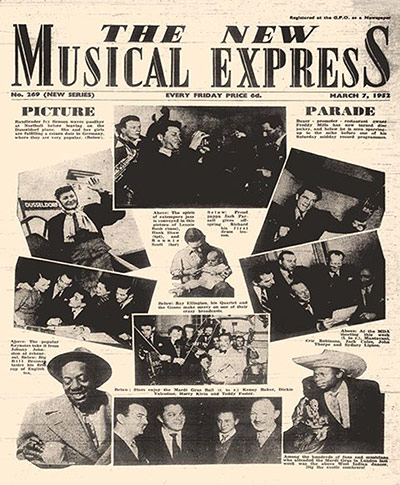
NME first started in March 1952, as 'The New Musical Express'. It was known for being printed on newsprint instead of glossy paper which was the norm for magazines. 

Similar to the the US magazine Billboard, in each issue it had the UK's weekly singles chart and was the first magazine to do so. The first No. 1 it had was "Here In My Heart" by Al Martino.
The magazine was very successful in the early 1960s under the editor Andy Gray, achieving 300,000+ figures during a 4 month period in 1964. Even during the psychedelic period of the late 1960s NME kept it's status as one of the UK's best selling music magazines.

As the 1970s arrived the magazine wasn't selling as many with rival Melody Maker overtaking it, which almost led to it's closure by owners IPC Media. Alan Smith was then made editor and turned the magazine into a new cynical style hiring new writers. He gave the editorial role to Nick Logan as the magazine started selling almost 300,000 copies a week outselling all of it's rivals.
Punk started to gain momentum in the late 1970s and this led to a more openly-political NME under Neil Spencer. The iconic logo which it still uses to this day in a modern form was brought in at this point.

The 1980s continued this trend, even having then Labour leader Neil Kinnock on the cover in 1985 and going as far as an interview with him in 1987. But hip-hop acts such as Public Enemy started to gain popularity with NME controversially covering them in the magazine leading to a rough patch of sales. Because of this decline Alan Lewis, who was a former editor of Sounds got brought in to save it. After a slow start this eventually proved to be a good decision and a commercial success.
Danny Kelly was made the new editor at the end of the 80s as Acid House and 'Madchester' both got popular.

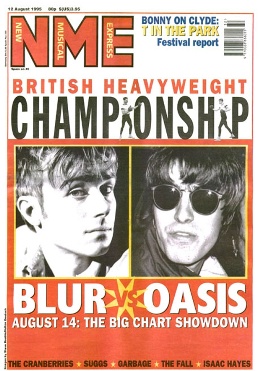
The early 1990s in NME had a large Alternative Rock influence from the USA with bands like Nirvana and Pearl Jam gaining much coverage. These and other American bands dominated the magazine over British ones, who still got some support. One noteworthy British band in this time is Manic Street Preachers who had a rivalry with the magazine. During this period artist Morrissey was featured on a lot of covers of the magazine, and eventually had a well-publicised dispute with the magazine after their allegations of racist lyrics in his music. He only eventually spoke to NME again in 1993 because the three writers involved then had left. When Steve Sutherland was made editor, a lot of the writers defected to sound and the British media started to be dominated by Britpop, two notable bands being Blur and Oasis. This was a new high for the paper who took part in publicising the chart battles, but as Britpop died so did the magazine's popularity going into the 21st century, with the late 1990s containing the magazine's ill-fated attempts of covering DJ's and trying politics again.

Long rivals Melody Maker was merged with NME in the 2000s, and the new editor became Ben Knowles. Gone was the old newsprint style and a more conventional glossy and colourful paper has been used. It attempted to gain new audiences by covering artists of different genres like Jay-Z and Aphex Twin but yet again this was unpopular. They brought in a new editor in Conor McNicholas and started covering British indie bands like the Kaiser Chiefs. Popular band Arctic Monkeys then became the main band covered by the magazine in the early 2000s. The magazine was criticised for it's lack of diversity in 2008, and it got redesigned to be aimed at an older audience.
Despite this, the circulation for the magazine has been getting lower every year to the present day, with Mike Williams the current editor.

Even though it isn't selling as many copies and nowhere near as popular as it used to be, NME has still been a hugely influential magazine and the legacy of it during it's high points definitely overshadow the recent demise.